Blogs
History and Eternity at the Pesach Seder
Posted Mon, 03/27/2023 - 09:27 by Lazzaroby Rabbi Daniel Lichman
Last year’s CCJ Rabbi-Clergy conference blew my mind.
I am a great lover of the work of German-Jewish theologian Franz Rosenzweig (1886 - 1929). Rosenzweig addressed a generation of Jews whose primary education was in western culture rather than Jewish sources. He established a philosophical paradigm through which Jews, like myself, could travel from outside of Judaism back to Torah. The paradigm he established is the very territory on which all of my Torah study and teaching takes place.
A curious part of Rosenzweig’s philosophy concerns the relationship between Judaism and Christianity. His (very difficult to read) masterpiece, the Star of Redemption is a theology of both Judaism and Christianity. He sees Judaism and Christianity to be interlinked: Judaism is a revelatory liturgical cycle which exists outside of history in eternity; Christianity takes that revelation out into the world in the realm of history.
I had thought of Rosenzweig’s Christian theology as an interesting curiosity. The excellent keynote talk by Professor Katherine Sonderegger showed me that this curiosity is in fact taken seriously by Christian thinkers. She described Rosenzweig’s theology as of a God who disrupts everything, a God which cannot be contained in nor considered within a secular paradigm. She also reflected on what his thought means for her in her religious life.
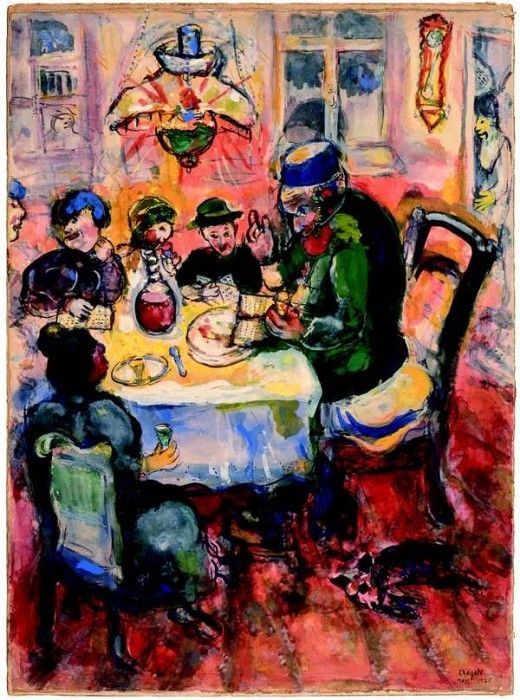
This Pesach Jews will read these lines from the Mishnah rendered eternal by their inclusion in the Haggadah:
In each and every generation a person must view themselves as though they left Egypt, as it is stated: “And you shall tell your child on that day, saying: It is because of this which the Eternal did for me when I came forth out of Egypt” (Exodus 13:8).
This is an excellent example of Rosenzweig’s point: the text invites Jews to collapse the past into the present or, put differently, to leave this current historical moment and take our place in our eternal story.
This year my colleague Hava Carvajal pointed out to me how significant it is that Jews do not gather around the Pesach seder and tell stories of how our descendents will be redeemed; we do not tell stories of the future. Instead we render stories of the past as the eternal present which becomes transparent to a redemptive future.
Influenced by Rosenzweig, the practice of collapsing history into eternity has become a cornerstone of my Jewish theology. Encouraged by my experience listening to Sonderegger’s Christian commentary on Rosenzweig, I am curious about what I might hear and what I might be called to articulate in an exploration of the categories of history and eternity in dialogue with Christian colleagues.