Blogs
A pilgrimage of hope
Posted Fri, 11/08/2024 - 15:24 by LazzaroRabbi and Priest reflect on a unique charity walk together to mark Sukkot and Harvest festivals

Raising money for the Trussell Trust and the Hunger Project, Rabbi Neil Janes from South Bucks Jewish Community and Father Stuart Owen, Rector of St Peter’s Church Berkhamsted, carried out a four-day pilgrimage in October – titled the Soul Food Walk – from Wallingford Castle in Oxfordshire to Berkhamsted Castle in Hertfordshire.
Their route retraced the steps of an event from 1242 – when the Jewish population of Berkhamsted was forcibly moved to Wallingford – while stopping at places that positively impact the community in the modern age. The walk was timed to take in both Sukkot and the Christian Harvest Festival.
Before the walk, they said: “We want to thank organisations that enrich the local community and recognise the many different ways in which our humanity is fed, including faith, sports, the arts, politics, healthcare, education and others.
“Both the Jewish and Christian traditions celebrate harvest festivals at this time when we give thanks for the food that nourishes our bodies, and this year, we wanted to combine that celebration with an act of thanksgiving for all those experiences which also nourish our souls.”
A website with updates and donation links can be found here.
What did you learn?
Rabbi Neil
We’ve come a long way since our first conversations together. We had these grand ideas about changing cultures of anonymity and humanising the people who are sitting opposite us in a café or on the train. Two middle-aged male clergy could just fix the world from a lovely café in Berkhamsted – if only everyone would listen to us! The world post-7th October felt so fractured and fragile and with so much mistrust and hate, the violence and the war that has followed has totally changed our world and I really did not know how to respond to the agony and pain – leading a community at the same time, which felt so fearful, sometimes desperate, and refusing to allow it to be defined by antisemitism has been the greatest challenge of my rabbinate. So I suppose the first thing I’ve learnt is about friendship – how to build friendships in communities and how to model friendship as leaders.
Father Stuart
Not long after Rabbi Neil and I first decided that we were going to make this pilgrimage, I shared our plans with someone I met on the High Street. Their immediate response was, 'And what difference is that going to make?' It was a question that really stung, perhaps not least because I could see what they meant; and to a great extent the implied criticism was valid. I had a great three and a half days walking through beautiful countryside with a good friend, but all that was painful and ugly about the world when we set off from Wallingford is just as painful and ugly today. What difference were we going to make? However I've learnt that notwithstanding that sort of scepticism (cynicism?) there are so many people out there who are really making a difference.
There are so many people out there who don't give up on the possibility of real change happening in their small corner of the world. And meeting up with those people, and stringing their stories together through our pilgrimage, felt like being part of a kind of insurgency of hope; being part of an underground of people who refuse to believe that we're all going to hell in a handcart. I learnt that there are so many people who believe in the possibility of change for the better and who rather than being dismayed by the bleak news which tends to dominate the headlines, just take that as an incentive to roll their sleeves up a little further and dig in a little deeper to make whatever change they can make, wherever they happen to be.
Rabbi Neil
Father Stuart talks about an insurgency of hope and that is really what we encountered. When we approached organisations and individuals to come and talk to us, it felt like a massive chutzpah (cheek) to write and ask: ‘Come and talk with us about what feeds your soul?!’ But instead of being too busy, people cleared their time to share what they are doing, how important they feel their work is, how it impacts on their world view and shapes their sense of self. In light of this, I think I probably learnt about the necessity of leadership – we, that is clergy but everyone else in leadership positions, need to model our work publicly and give people tools and vocabulary to share how their worldview can not just ‘live alongside’ worldviews that are, in some cases, quite fundamentally different, but actively enrich each other and our society. You don’t need to bow to voices of hate and division – find good partners, work together, build trust. It’s obvious I guess but we all need reminding sometimes.
What inspired you?
Father Stuart
Our first stop on the pilgrimage was at Wycombe Wanderers FC where we met two outstanding young men, Lewis and Jack. Lewis works with the football foundation there and Jack is a recently signed player. Hearing them talk about the ways in which they were able to encourage and inspire others was, in itself, encouraging and inspiring. Those two guys really set the tone for all that followed. Again and again in the course of our journey I was inspired by the many different ways in which people were out there making a difference in their communities, day in and day out.
The other really inspiring element of the pilgrimage for me - and this risks being at best self-referential and at worst self-adulatory - was how much our walk together seemed to inspire others. (I've turned beetroot red just typing that!) But to desperately try to change gear and bring myself back down to earth, I didn't really imagine for one moment that so many people would be enthused by two middle-aged clergy going for a bit of a walk together. I thought we'd enjoy walking together for a few days, raise some money for charity, take a few selfies, and that would be it. I was wrong about that. The fact that our local radio station ended up interviewing us three times in just six days suggests that something about what we were doing really caught people’s imagination.
Rabbi Neil
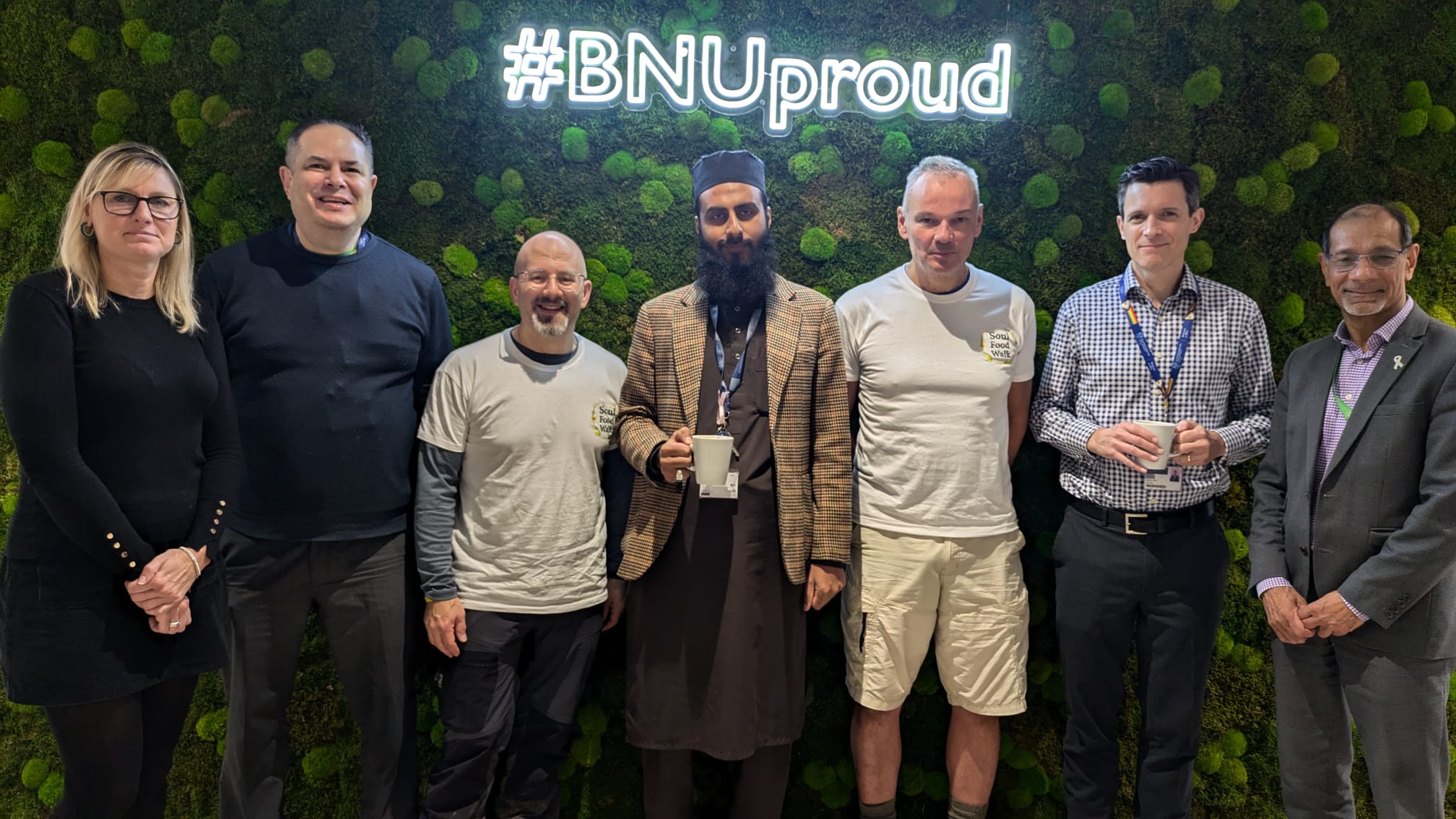
I absolutely loved meeting the chaplaincy team at Stoke Mandeville and the welcome poster created by the young transplant patient. In a medical environment, to hear the chaplains talk about just ‘being at the right place at the right time’ and the need for hope being so important for healing was really incredible. They also laid on an incredible spread of food, which by the time I was practically hobbling at the end of the day, totally lifted my spirits. Stopping at the university where the Imam who heads chaplaincy, a councillor, and Thames Valley Police representative all made time along with a Jewish law lecturer and a member of the university management was equally inspiring – yet again, at the heart of our visit was a cup of tea, something that Imam Haseeb makes a central part of his chaplaincy. Being inspired by hospitality sounds mundane but really it is such a core component of so many religious communities, like Reverend Jane’s efforts when our Friday night service was hosted by the church in Tring ‘mid-walk’ – I was inspired to think how we could create space to break bread and host each other more. Personally, these ideas crystallised at the Tring Brewery – for obvious reasons!
What did you find hard?
Father Stuart
I absolutely love being out in the countryside and making the kind of journey that we were on, so for me the hardest part was stopping. I hate it when the last step has been walked and I have to take off my boots, pack away my rucksack, and get back to sleeping in the same place night after night. Given my love of the semi-nomadic life, becoming a parish priest, the very quintessence of 'parochial', probably wasn't the wisest career choice I could have made!
Rabbi Neil
I was really a bit anxious about the walk – it’s been a long time since I walked a substantial distance and I felt not just out of practice but a bit intimidated by Father Stuart’s walking experience! But once I overcame that challenge (and the blisters), the hardest thing was thinking that the momentum for change we helped generate could stop. Thankfully, Laura Kyrke-Smith, MP for Aylesbury, who joined us on the walk asked a question in parliament about interfaith work and our communities were really inspired, which all gave me the little push to find some new energy to plan for the future.
What about the future?
We’re not putting our walking boots away just yet (well Neil’s buying some new ones). We like being part of the insurgency of hope. We believe that this first journey is creating a roadmap for more to follow. Would you like to journey with us?