Blogs
Prophecy and Piety: Rabbi Abraham Joshua Heschel’s Legacy for Religious Leaders Today
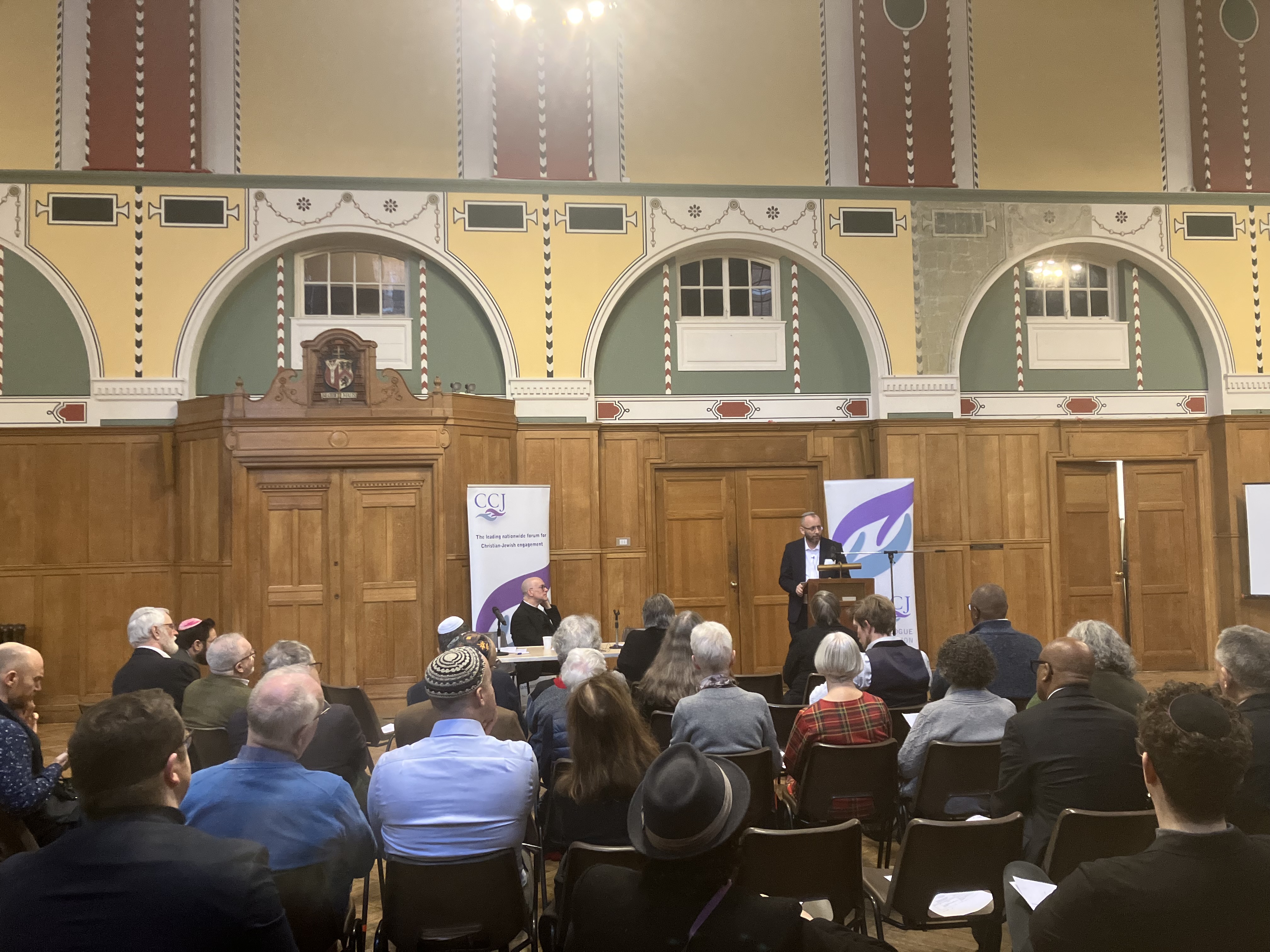
Posted Fri, 11/24/2023 - 10:28 by LazzaroWe publish the keynote speech given by Dr. Dror Bondi at the CCJ Rabbi-Clergy Conference on 23rd November 2023 at Westminster Cathedral Hall.
Shalom,
Thank you so much for inviting me. It is a great privilege for me to speak here today about Rabbi Abraham Joshua Heschel’s Legacy. Heschel was the prominent American Jewish thinker of the twentieth century and the leading Jewish voice for interfaith dialogue – and I am only his Hebrew translator…
In 1951, Reinhold Niebuhr, America’s leading Protestant theologian, predicted that Heschel would
become a commanding and authoritative voice not only in the Jewish community but in the religious life of America.
And indeed, during the Sixties, Heschel developed close friendship and partnership with Reverend Martin Luther King, led an inter-religious movement against the war in Vietnam, and even influenced global religious life when he was deeply involved in the Second Ecumenical Council of the Vatican.
In November 1965, Heschel joined the faculty of the Union Theological Seminary of New York as the Harry Emerson Fosdick Visiting Professor. He was the first non-Christian in the faculty of this important Christian seminary, and it was necessary formally to change its constitution in order to appoint him.
“No Religion Is an Island” – this was the title of Heschel's opening lecture there, and he opened it on a personal note:
I speak as a member of a congregation whose founder was Abraham, and the name of my rabbi is Moses. I speak as a person who was able to leave Warsaw, the city in which I was born, just six weeks before the disaster began. My destination was New York, it would have been Auschwitz or Treblinka. I am a brand plucked from the fire, in which my people was burned to death...
In my talk I will relate to the main claims of Heschel’s lecture, but first let me also start on a personal note. Several months ago, with the support and effort of Rabbis for Human Rights, I initiated an interfaith march in Jerusalem in order to mark the fiftieth anniversary of Heschel's death. Christian, Muslim and Jewish leaders "prayed with their legs" – as Heschel saw his own famous march with Martin Luther King – for peace, partnership and justice. Indeed, it was one small step for the interfaith dialogue, but one giant leap for me.
I grew up in a settlement, in a hardcore right-wing environment. I was educated to believe that God supports Jewish supremacy: that the only way to worship is by Jewish Law, in the Land of Israel and as an ethnic Jew. I was taught that even the English language takes you away from God. Only when I met Heschel – thorough his writings – my eyes were opened and I realized that the Revelation of our days was given in English, and that God is neither racist nor fundamentalist.
Heschel freed my soul from the prison of my narrow, religious and national identity, by teaching me the perspective of God, who creates all human beings in His likeness. Moreover, Heschel helped me see the challenge to live out one's identity and tradition as a continuous interpretation of the moral demand of the universal God. In this sense, only due to Abraham Joshua Heschel's writings can I also speak of myself as "a member of a congregation whose founder was Abraham…" – and to add that my Rabbi was Abraham as well… In short, my scholarship and my translations are only a means by which I try to live as Heschel's disciple and to transform Israel through his spirit and message.
The title of my talk is "Prophecy and Piety", for Heschel saw the link between them as very important to the understanding of the religious experience, as well as interfaith dialogue.
Of course, there are many ways to understand these two terms, and thus also the relationship between them. Let me first clarify that when I speak here about "Prophecy" I don't mean divine knowledge about the future, but revelation, namely the very moment in which God turns to a human being, or more precisely, I am speaking about the biblical phrase: "Thus said the Lord".
What is the meaning of this phrase, which is the most common phrase in the Bible?
There are dogmatic approaches which see this phrase as an objective source of religion. According to such approaches, a religious text is ultimate and authoritative due to its divine source, not its internal meaning. The basic step of the reader is to accept the authority of the text, and only then to try to force himself to believe in its content – often without deep understanding of its meaning.
Indeed, the dogmatic approaches to prophecy see religion as a creed which one must accept rather than an authentic experience and understanding, and it is no surprise that this has a direct link to the piety of obedience. When one's first step is an acceptance of divine arbitrary authority, this step represents a retreat from human independence. The main challenge of such piety is to fulfill the divine demand, through beliefs or through deeds, while the question of authentic experience and understanding is much less important.
Moreover, such piety has no essential connection to moral issues. Of course, if the religious text demands moral behaviour, the pious person obeys this demand, but the moral relationships between human beings have no intrinsic value in such a religious world. When the ultimate test of piety is obedience, morality loses its imperative power. That's why, unfortunately, evil leaders can easily use the power of religious texts in order to lead believers to act immorally.
Another problem of the dogmatic approach is its implications for interfaith dialogue. When the source of my religious obligation is my religious text, your religious text is not relevant. Religious text is text – and like any other text it uses specific language and words, written in historical context, and relates to one religious tradition or even one ethnic group. Seeing one religious text as the objective source of religion leads to an objectification of one religion, as if it were ultimate Truth in itself. When I see my religious text as the ultimate reflection of the Ultimate Object, other religions cannot be more than shadows. And how can we really meet someone from another religion, with respect and appreciation; how can we deeply listen to his words, to her experience, when we relate to each other in such a way?
What is the alternative that Heschel suggests to us?
In a sense, Heschel's life was a journey towards suggesting an alternative understanding of prophecy, piety and the link between them. He was born into a Hasidic dynasty, which taught him to live in the presence of God, in the piety of devotion, not mere obedience. He refused to adopt the Hasidic tradition of inheriting his father’s place simply because he was his son, and he went to Berlin to study philosophy – but when he witnessed liberal democracy’s descent into fascism, he sought an alternative. He decided to dedicate his PhD dissertation, The Prophetic Consciousness, to a phenomenological understanding of prophecy – as a kind of a journey to an alternative land of the ancient prophets of the bible. Six weeks before the Second World War he escaped from Europe, thorough London, to the US – and his first English article there was entitled "Piety". In 1955, he combined prophecy with piety when he titled his central book God in Search of Man: A Philosophy of Judaism. And on 1968 he was described by Martin Luther King as a prophet:
[Heschel is] a truly great prophet… forever seeking to make the great ethical insights of our Judeo-Christian heritage relevant in this day and in this age… always standing with prophetic insights to guide us through these difficult days".
Heschel was born to piety and died as a prophet, and all his works run between these two terms. But how exactly did he understand them?
Let's start with his PhD dissertation. How did Heschel dare to understand prophetic consciousness? In his introduction to its English version, which he published in 1962 as The Prophets, he confessed that the prophets themselves changed his method, since he wrote about their consciousness thirty years before. In the beginning he used a purely phenomenological method: he suspended any judgment, even the question of whether prophecy is a true experience before God, in order to gain insight into prophetic consciousness:
It is in being involved with a phenomenon, being intimately engaged to it, courting it, as it were, that after much perplexity and embarrassment we come upon insight – upon a way of seeing the phenomenon from within.
But is prophetic consciousness just another phenomenon? Indeed, Heschel confesses that during his phenomenological research of the prophets, they came back to life and demanded him to respond through his own experience to their experience:
In the course of listening to their words one cannot long retain the security of a prudent, impartial observer... Pure reflection may be sufficient for the clarification of what the prophet's consciousness asserts – but not for what his existence involves. For such understanding it is not enough to have the prophets in mind; we must think as if we were inside their minds. For them to be alive and present to us we must think, not about, but in the prophets, with their concern and their heart. Their existence involves us. Unless their concern strikes us, pains us, exalts us, we do not really sense it.
How did Heschel dare to understand the experience of prophecy? His answer is: the prophets called him to do it. They didn't speak about God, but rather they felt God's pathos and responded with their own sympathy. And now, their sympathy with God's pathos demanded that Heschel respond with his own sympathy if he wanted to understand them. Previously he had simply tried to be attentive to their words, but then felt their words travel from God’s heart into his own. When someone tells you "I love you" the only way to understand it is to be in mutual love. Of course, you don't have to accept such a saying if there is no real love between you, but you simply cannot understand the specific meaning of the phrase without responding with real love.
In the same way, "Thus said the Lord" is not a mere claim of authority. Rather, through these words the prophets claim that we can understand them, that we can meet God through their words, or to put it in another way: that there is a link between their prophecy and our piety. Piety is not a mere obedience to an Ultimate Other, and religion is not an objective reflection of the Ultimate Object. The prophets bore witness to God's turning to humanity, and through their words we can meet Him as Ultimate Subject, in His interpersonal turning toward us. They didn't speak about God, they spoke from His perspective. And suddenly all the world is seen differently…
Every time we experience wonder at our very being, for the miracle of every flower – we understand our existence as God's gift, as His demand to find our meaningful destiny. Every time we experience deep fellowship with another human being, with every kind of human suffering, we feel how God's parenthood has opened our hearts to relate to each other as siblings.
Heschel dedicated his thought to invite us to such moments of experience. His philosophy is psalms, his theology is theophany. Pious people who read Heschel will deepen their relationship with God, with God's creation and with all God's children. And – even, and especially – if these God's children live and believe another religion.
How does such a religious experience create this paradigm for interfaith dialogue? Let’s go back to Heschel's words in his lecture "No Religion is an Island", to his main paragraphs which directly describe this relationship:
On what basis do we people of different religious commitments meet one another? First and foremost we meet as human beings who have so much in common: a heart, a face, a voice, the presence of a soul, fears, hope, the ability to trust, a capacity for compassion and understanding, the kinship of being human. My first task in every encounter is to comprehend the personhood of the human being I face, to sense the kinship of being human, solidarity of being.
To meet a human being is a major challenge to mind and heart. I must recall what I normally forget. A person is not just a specimen of the species called homo sapiens. He is all of humanity in one, and whenever one man is hurt we are all injured. The human is a disclosure of the divine, and all men are one in God's care for man. Many things on earth are precious, some are holy, humanity is holy of holies. To meet a human being is an opportunity to sense the image of God, the presence of God. According to a rabbinical interpretation, the Lord said to Moses: "Wherever you see the trace of man there I stand before you..."
When engaged in a conversation with a person of different religious commitment I discover that we disagree in matters sacred to us, does the image of God I face disappear? Does God cease to stand before me? Does the difference in commitment destroy the kinship of being human? Does the fact that we differ in our conceptions of God cancel what we have in common: the image of God?
God's perspective dwells here, as every meeting with another human being presents an opportunity to see through God's eyes. In this sense, all real piety is a kind of a prophecy. Just as the book of Genesis sees God's image in every human being, just as the prophet Amos saw God's justice in history, so my grandmother felt God in her kitchen when she was kind to every human being. And every human being can live it out. It is not about your social belonging to a religion; you can even be a secular. Standing before God is not only a religious experience; it is a human experience. Actually, you need only remember that your religious tradition is not ultimate like God Himself, you need only be careful not to idolize your religion.
After the personal opening of his lecture, Heschel stressed that this understanding has relevant meaning in his time:
Nazism in its very roots was a rebellion against the Bible, against the God of Abraham. Realizing that it was Christianity that implanted attachment to the God of Abraham and involvement with the Hebrew Bible in the hearts of Western man, Nazism resolved that it must both exterminate the Jews and eliminate Christianity, and bring about instead a revival of Teutonic paganism.
Nazism has suffered a defeat, but the process of eliminating the Bible from the consciousness of the western world goes on. It is on the issue of saving the radiance of the Hebrew Bible in the minds of man that Jews and Christians are called upon to work together. None of us can do it alone. Both of us must realize that in our age anti-Semitism is anti-Christianity and that anti-Christianity is anti-Semitism…
Is Judaism, is Christianity, ready to face the challenge? When I speak about the radiance of the Bible in the minds of man, I do not mean its being a theme for "Information, please" but rather an openness to God's presence in the Bible, the continuous ongoing effort for a breakthrough in the soul of man, the guarding of the precarious position of being human, even a little higher than human, despite defiance and in face of despair.
The supreme issue is today not the halacha for the Jew or the Church for the Christian – but the premise underlying both religions, namely, whether there is a pathos, a divine reality concerned with the destiny of man which mysteriously impinges upon history; the supreme issue is whether we are alive or dead to the challenge and the expectation of the living God.
This is a very unique interpretation of Nazism as an anti-religious movement. Indeed, the Nazis claimed that they hated the Jews because we are an inferior race, but Heschel understood that this hate was rooted in the hate of what we represent: the faith in One God which is the very opposite of racism. This how Judaism and Christianity are aligned: the main battle is not between different religions, but between fascism or religious hatred and the one and only God of all humanity. Only when religious people forget God do they become fundamentalists; only when we let fascists take over our religions and to make them idolatries do we fall into paganism.
And, vice versa, only standing before God can lead us to peace. After the Six Day War in 1967, Heschel quoted Isaiah and declared:
"In that day Israel shall be a third with Egypt and Assyria, a blessing in the midst of the earth, which the Lord of hosts has blessed, saying Blessed be my people Egypt and Assyria, the work of my hands, and Israel, my inheritance" (Isaiah 19). In the days of the prophet Isaiah, Egypt and Assyria were locked in deadly wars. Hating each other, they were both the enemies of Israel. How did Isaiah, the son of a people which cherishes the privilege of being called by the Lord "My inheritance," feel about Egypt and Assyria? The God of Israel is also the God of Syria, the God of Egypt. The enmity between the nations will turn to friendship. They will live together when they serve together.
Or as Heschel's words in "No Religion is an Island":
The first and most important prerequisite of interfaith is faith. It is only out of the depth of involvement in the unending drama that began with Abraham that we can help one another toward an understanding of our situation. Interfaith must come out of depth, not out of a void absence of faith. It is not an enterprise for those who are half learned or spiritually immature.
Of course, Heschel continues, we should be careful that interfaith dialogue will not become a new religion:
At a time of paucity of faith, interfaith may become a substitute for faith, suppressing authenticity for the sake of compromise. In a world of conformity, religions can easily be levelled down to the lowest common denominator.
Both communication and separation are necessary. We must preserve our individuality as well as foster care for one another, reverence, understanding, cooperation… The problem to be faced is: how to combine loyalty to one's own tradition with reverence for different traditions? How is mutual esteem between Christian and Jew possible?
Heschel’s answer is: humility. Indeed, as human beings we will always live in a tradition, within our interpretations of God's will. However, we must remember that our tradition is not perfect; it is but our relationship with God. The hate begins when one identifies his or her specific tradition with the one God. Or in Heschel's words:
Religion is a means, not the end. It becomes idolatrous when regarded as an end in itself. Over and above all being stands the Creator and Lord of history, He who transcends all. To equate religion and God is idolatry.
Does not the all-inclusiveness of God contradict the exclusiveness of any particular religion? The prospect of all men embracing one form of religion remains an eschatological hope. What about here and now? Is it not blasphemous to say: I alone have all the truth and the grace, and all those who differ live in darkness, and are abandoned by the grace of God?
***
Now I have to stop for a moment and to let you know something about the writing process of my speech. I was asked to submit my speech for comments two months ago. Indeed, in the end of September I submitted a draft of the words I spoke up to this point, without writing the end of my speech. I have to confess that since Covid, I lost my confidence in the world: who knows what will be tomorrow? And, indeed on October 7th my world was crushed, my faith was burned in the fire of terror.
The horrible fundamentalist terror attack that day destroyed our life in Israel, forced our people – including all the men in my family between ages 18 to 40 – to go to war, and forced me to rethink my faith, especially my position on inter-religious dialogue. Unfortunately, this is our harsh new reality (I am writing these words on October 24, and who knows what will be tomorrow…).
Before this disaster I believed that inter-religious dialogue could be the key for peace in the Middle East. I knew that Islam had good relationship with Judaism during the Middle Ages – much better than Christianity – and I thought that only fascism destroyed Judaism and Islam, the good relationship they had. However, I can't believe in this anymore, at least not without additional moral clarification. Of course, I know Muslims who are good human beings and are my good partners in inter-religious dialogue and peace work, but the challenge now, in our new context, is to draw the clear moral line which explains who should be part of inter-religious dialogue before God and who belongs to the devil’s forces.
However, here again I find the answer in other words of Heschel:
What is an idol? Any god who is mine but not yours, any god concerned with me but not with you, is an idol. Faith in God is not simply an afterlife-insurance policy. Racial or religious bigotry must be recognized for what it is: blasphemy.
The parenthood of God is the source of interfaith dialogue between siblings, and at the same time is the source for the moral line: the paganism of anti-solidarity, of racial or religious bigotry is blasphemy against the parenthood of God. Or in Heschel's words from "No Religion is an Island":
Above all, while dogmas and forms of worship are divergent, God is the same… there are levels of existence where Jews and Christians meet as sons and brothers… all men are sons of one father, but they have also the power to forfeit their birthright, to turn rebels, voluntary bastards… It is not flesh and blood but honor and obedience that save the right of sonship. We claim brotherhood by being subject to His commandments. We are sons when we hearken to the Father, when we praise and honor Him.
You simply can't forge solidarity with fundamentalists who hate you. You can't do inter-religious dialogue with someone who idolizes his own religion and sees all the partners of another religion as objects for murder simply because they belong to another religion. In fact, the inter-religious world should unite now in condemnation of such a paganism. At the same time, please join in my deepest prayer that Israel will be careful to fight only against terrorists, with the greatest effort made not to harm innocent civilians. Indeed, we were forced to go to war in order to save the Jewish people, but we must force ourselves to be sensitive to innocent life in order to remain a moral state. An immoral state cannot be a Jewish state.
And please, please, pray together that the hostages will come home soon.
A few days after the disaster, Heschel's daughter, Professor Susannah Heschel, sent me his following words, from a speech he delivered to a Christian audience in Frankfurt am Main in 1938. I will end my speech with them:
Emblazoned over the gates of the world in which we live is the escutcheon of the demons. The mark of Cain in the face of man has come to overshadow the likeness of God. There has never been so much guilt and distress, agony, and terror. At no time has the earth been so soaked with blood. Fellow men turned out to be evil ghosts, monstrous and weird. Ashamed and dismayed, we ask: Who is responsible?...
There is a divine dream which the prophets and rabbis have cherished and which fills our prayers, and permeates the acts of true piety. It is the dream of a world, rid of evil by the grace of God as well as by the efforts of man, by his dedication to the task of establishing the kingship of God in the world. God is waiting for us to redeem the world. We should not spend our life hunting for trivial satisfactions while God is waiting constantly and keenly for our effort and devotion.
Thank you very much.