Blogs
Fragments of Memory
Posted Thu, 11/09/2023 - 11:26 by LazzaroA reflection on our recent Poland Study Tour
by CCJ Senior Programme Manager James Roberts

In the historic Jewish quarter of Krakow, Poland, a cemetery surrounds the Remah Synagogue. Its headstones mark the graves of some of Krakow’s Jewish inhabitants, including Rabbi Moses Isserles the Talmudist and expert in Jewish law. At the exit of the cemetery, there is a wall which separates the cemetery from the street. Instead of being made up of ordinary stones or brick, this wall is covered by fragments of Jewish tombstones. These pieces of tombstones, matzevot, originally stood in the cemetery, but were destroyed during the war and shattered into pieces. After the War ended, some of these pieces were reassembled to form a lapidarium, a curated display of stone artefacts and monuments. Looking at it now, you can see sections of carved inscriptions in Hebrew, floral and decorative motifs, animal figures (a lion’s head, perhaps); fragments of the tombstones they used to belong to.
In many ways, this lapidarium symbolises the complexities around memory and remembrance of Jewish life in Poland. It is a reminder of the diversity of Jewish life and culture in the country before the war, and a memorial to the lives which the tombstones originally commemorated. The lapidarium is also a physical symbol of the brutal shattering and destruction of Jewish life in the Holocaust, which is visibly seen in the cracks and fragments. Yet the monument is also a testament to the subsequent attempts to piece together this story, albeit incompletely.
From 22nd October until 28th October, the Council of Christians and Jews led a group of senior Christian leaders across Poland, learning about Jewish life in the country before, during and after the Second World War. Over the course of our week together, we learned about these pieces of Jewish history, the fragments which they have left behind, and the efforts to keep alive the memory of those who were killed in the Shoah.
We learned about the vibrant, diverse, Jewish history of Poland. We travelled through this 1,000-year-old history at the POLIN museum which documents Jewish history from the medieval period up until the present day, through fluctuating times of stability and persecution. We heard pre-war stories of Jewish individuals from Poland and visited their graves in the Warsaw Jewish cemetery including playwrights, artists, and politicians. We saw material signs of personal identities in the symbolism of these graves – candles representing domestic life, books symbolising learning, ships, and other markers of trades; signs of the skills and interests of the individuals buried there. Before the Second World War, Poland was home to over 3 million Jews, and was a centre for Jewish culture in Europe. This is an important piece of Jewish and Polish history.
In contrast, we also learned about the Nazi campaign to wipe out Jewish life and culture, with its terrifying, bureaucratic efficiency. We visited Ghettoes in Warsaw, Lodz, and Krakow, learning about the inhumane conditions that Jewish people were forced into and the increasing deprivations of their rights and dignities. We crouched in the cellar of the Zabinski Villa, where Jan and Antonina Zabinski hid and protected their Jewish friends whose lives were confined to tiny dark rooms. We stood at Radegast train station, where Jews were deported from the Lodz to their deaths at extermination camps. And we stood in silence at Auschwitz-Birkenau as we walked through the barracks, past the crematoria and through a gas chamber.
Throughout Poland, it is possible to sense the absence of Jewish life following the Shoah. There is a ‘presence in absence’ which the Holocaust created. We sense this when we see the outline on a doorframe where a mezuzah used to be or when we realise that the café where we are sitting used to be a synagogue. It is when one notices these things that the sense of complete destruction becomes tangible.
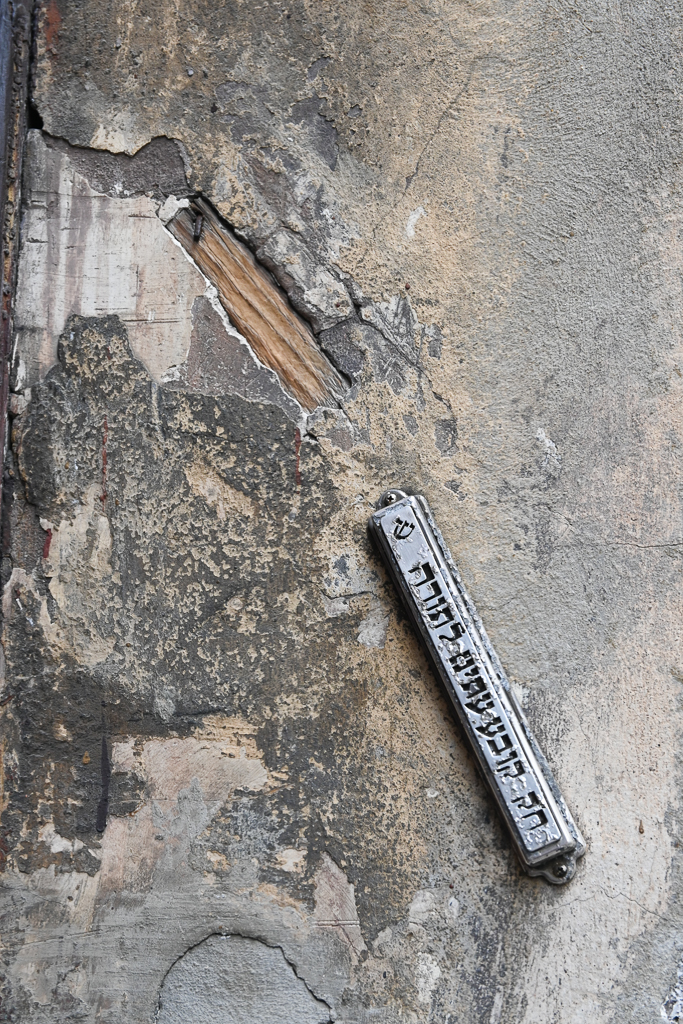
Words fail to describe the horrors of these memories. But by standing in these spaces of trauma and memory, by listening to the stories, we become witnesses to the horror (as Wiesel famously said). It is then, in turn, our duty to testify to the past and to keep the memories alive.
We met with a number of inspirational Jewish leaders who doing just that – people who are keeping their history alive in Poland, not least our partners at the Taube Center for Jewish Life and Learning, Helise Lieberman, Moshe Yaakov Kis, and Kaja Siczek, whose work is an inspiration. We met with the Chief Rabbi of Poland, Rabbi Michael Shudrich, and the academic and co-chair of CCJ in Poland, Prof Stanislaw Krajewski. We visited the young and vibrant Jewish Community Centre (JCC) in Warsaw, and celebrated a meaningful Shabbat dinner at the Krakow JCC in the company of Jewish community members and visitors from all over the world. We also met with a number of Christian leaders who consider it their duty of solidarity to keep Jewish memory alive – whether that is through cleaning and restoring Jewish cemeteries, combatting contemporary antisemitism, or by fostering deep and fruitful interfaith relationships.
We also grappled with the complexities of how to communicate and portray Holocaust memory. Throughout our programme, we engaged with contemporary issues in Poland and thought about how the country has framed its history, for better or for worse. We became very aware that how memory is framed is vitally important. For Poles, this may mean wrestling with the difficulties around resistance or collusion with the Nazis, and for Christians this is not dissimilar – when we remember the Holocaust, do we simply highlight the virtuous actions of Christian Righteous Among the Nations, or do we also grapple with the long shadow of Christian anti-Judaism which was the soil on which so much 20th Century antisemitism sprouted?
Learning about the atrocities of the past is vital, but it is also important to ask what we do with that knowledge now. To return to the lapidarium in the Krakow cemetery, what do we do with the fragments of memory which we possess, and how do we piece them together?
If we have heard the stories of horror and persecution, we become witnesses to that history, but we also become guardians of memory (oftentimes, a memory which does not belong to us). Our visit to Poland impressed the importance of sharing these memories, witnessing to the pain of the past, and framing these memories honestly and sensitively. These memories, these fragments of persecuted Jewish life, should motivate us (whatever our faith or background) to speak out against antisemitism, to counter hatred, to build rather than tear down, and to testify to the words inscribed at the entrance to the Ringelblum Archive; ‘what we’ve been unable to shout out to the world’.
At a time when antisemitic incidents have increased exponentially, this remains a pressing task.
We are grateful to the generosity of our funders for this programme, and without them it would not have been possible: the Claims Conference, the Association of Jewish Refugees, the Greek Orthodox Archdiocese of Thyateira and Great Britain, and the United Reformed Church Interfaith Fund.
For more information about this programme, see here: https://ccj.org.uk/news/poland-trip