Blogs
Faces of Faith: Kenneth Awele Okafor
Posted Thu, 03/07/2024 - 12:48 by Lazzaro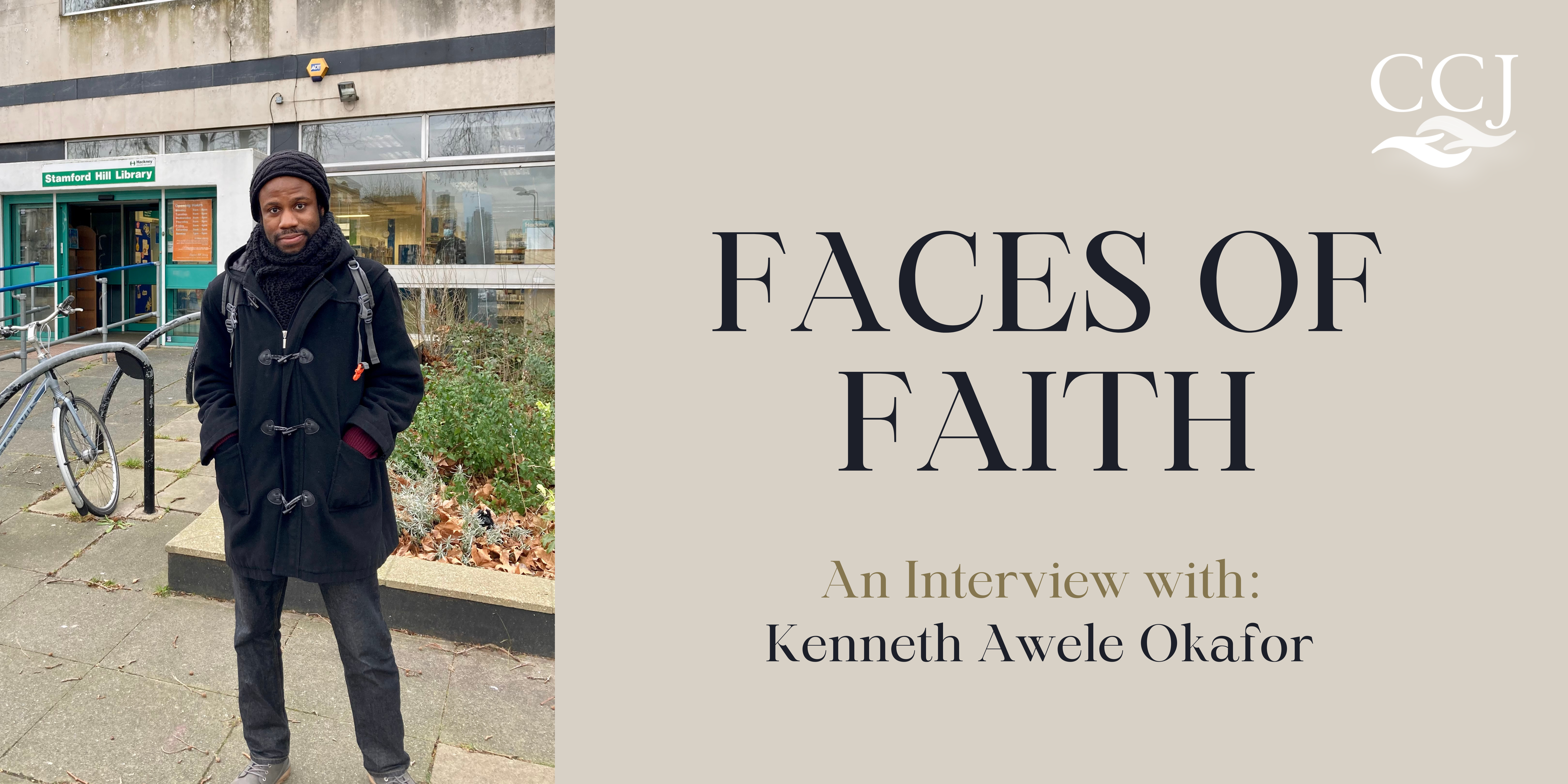
Kenneth Awele Okafor is a Black British Jew of Nigerian Igbo ethnicity who also has West African, North African, East African, and Middle Eastern ancestry. He pushes for Jewish communities in Nigeria, Ghana, Kenya, and South Africa to promote their Jewish identity, often intermingled with African cultural traditions. He was the former co-ordinator of the JW3 Young Advisory Group which formerly led the JW3 Young Jews of Colour organisation for Jews of Afro-Caribbean, Asian, and Middle Eastern descent. Kenneth is included in the book "What Does a Jew Look Like?" by Keith Kahn-Harris and Robert Stothard, which investigates portraits of British Jews that illustrate some of the many ways men and women might be Jewish in Britain today.
Why Stamford Hill Library?
The reason why we chose the Stamford Hill Library as our meeting spot is that this is the place I always go to collect books but also the first place I recognised Judaism as a religion. When I was seven years old I was referred to a speech therapist because I had difficulty reading and writing. I was referred to a special educational needs support unit where there were tutors to help me within a small class. The main reason I chose Stamford Hill library was that this is where those classes were, and we would walk here and that is how I first came into contact with Jewish customs and identity.
Prior to learning about Judaism, when I was seven years old, my mum and dad were telling me stories about the Igbo being the lost tribe of Israel - in terms of similar customs to the Jewish people. For instance, doing circumcision on the eighth day, immersion relating to the menstrual cycle, similar festivals - resembling Shabbat for example. With regard to community set up, there is a chief who would deal with major political issues within our space. There are similar stories. When the British first discovered the Igbos before colonisation, they were quite amazed by the resemblance to the Jewish people.
How did you develop from an interested child with stories of your own heritage, to becoming a more affiliated Jew?
In the mid-2000s, more research on the Igbo people being the lost tribe of Israel was being published. One of my own cousins who is Jewish was telling me about their own experience of becoming Jewish. There were intriguing articles for example about theories which relate the Hebrew language to the Igbo language - that could be true, it may not be - but there may be small fragments of influence... It’s something I was intrigued by, even though people did tell me not to convert, I was enjoying learning about Judaism.
How does Judaism fit with your day to day life, what does faith mean to you?
Being Jewish is all about being aware of people’s needs, understanding that it’s your duty to achieve what is best for other people alongside a deeper understanding of self. Especially when it comes to being empathetic, Judaism is about always trying to be aware of other people.
When it comes to being more innovative and creative in my work in architecture and interior, Jewish text definitely inspires me. For me, the idea and building of the tabernacle is the best part of the sections in the passages after the exodus. When it comes to the materiality and the construction elements of the wood it’s all about being very creative and very innovative and I’ve always loved that section in terms of the features and the function - I think what gets me is the dealing with the detail…
My ancestors were craftspeople, silversmiths especially. So, this portion speaks to me as an Igbo Jewish architectural designer. The subtlety and detail of building something from scratch to an impressive size always impacts me. This message speaks to me when I’m building houses, or community centers for people in need, for example a recent extension space I designed for someone with autism. So I always think you have to reward Hashem [G-d] by giving back, and think about building for the younger generation. So I think about the Torah, the passing of legacies of one generation to another in terms of architecture - building homes that people can afford, people can live in those spaces, making sure they can record those memories and record moments - that’s what I want to do, and I can easily refer to the Torah in those ways.
What I like about Judaism is that it’s all about those practical aspects to do things for the community… As an architect you learn this too and realise that design is a process; it’s the same thing being Jewish - it’s an ongoing process of learning and implementing new knowledge. The more you learn, the more you grow as a person - understanding people’s struggles, difficulties and finding ways to build dialogue full of support and understanding. That’s my way of understanding being a Jew in a communal space.
How do you feel about Interfaith? Has your attitude changed since you’ve taken on more as a Jew or has it been encouraged by it?
I think it’s encouraged by that. At the moment I have this work in progress of creating an Afro-Caribbean interfaith dialogue among people who are divided - Afro-Caribbean Muslims, Christians, Jews. Just to be in a space where we can learn about each other and understand issues facing others. For example, antisemitism in the Afro-Caribbean community is quite high, so finding places where we can express our voices or have those voices amplified and cut down antisemitism and islamophobia, is important.
I think interfaith is easier for me because I have a background of understanding. I wrote my dissertation on Islamic Architecture and studied Islam. I have a good understanding of the New Testament and have been to different churches - so I do have a working understanding of Muslims and Christians and where they are coming from. Also being Jewish it's easy for me to learn - okay this is how they practice, I need to respect their faith. Having Christian and Muslim members of my family I understand their practice and it gives me an advantage when learning how they can embrace themselves in their identity and finding ways to fight against all forms of hate on their behalf.
How do you view the development of African Jewish identity/ies?
When I do work with African Jewish communities, I try to put across that I want people to build their own African Jewish identity. So when it comes to adopting customs - most African Jewish communities adopt Ashkenazi or Sephardi customs - I want them consider selectively implementing them perhaps, or using those customs as a framework to build an African Jewish heritage in order to reinforce an existing Jewish identity.
Given the rejection of certain African Jewish groups as Jewish by the State of Israel and others going back decades, this trend of adopting Ashkenazi or Sephardi customs is understandable, but I do encourage people to build up their own identity… After all, Ashkenazim, who are originally descended from the Middle-east have kept that heritage despite settling in Europe, and we can also be Jews in our own identity. We don't have to dress-up as Jews. We have our own African music, food and culture. We can implement our Jewish life within that culture.
I am currently on a project exploring my heritage and ancestry around Africa. I discovered that I have a small percentage of Mizrahim (Yemen), Ethiopian Jewish, West Asian (Turkish) and North African Maghrebi heritage that is linked to Northern Nigeria via the Hausa tribe and looking into how assimilation played a part after the destruction of the 2nd temple and decided to settle within West Africa. I contacted a few distant relatives with Jewish ancestry from the US and South America, and it was intriguing to find some connections.
Have you had to deal with racism against African Jews?
A lot of Jews in Britain have heard about Ethiopian Jews but almost always their knowledge of African Jews is limited to the Ethiopian Jewish Community. When other Jews in Africa are brought up there is usually curiosity. It has surprised me when I have come across Rabbis who are aware of Igbo Jews. For example, I met Rabbi Jeffery Newman through WhatsApp last year and he in particular worked with the Igbo during the Biafran War and donated food and water to the community during the Nigerian Civil War.
I think curiosity is one thing - they don’t know if these people are Jews or not. People aren't so used to seeing Black Jews, so not just African but Caribbean - there are a few Caribbean Jews living in the UK that are involved in both their Caribbean and Jewish heritage and they face similar circumstances to African Jews… I do get asked questions about Black Jews, some people do know something, some people don't know anything, and some people get a bit irritated about it. That’s quite a common thing. Even when I talk about my Mizrachi heritage, people can be confused. I think there is a lot of skepticism towards non-Ashkenazi and non-Sephardi movements within Judaism.
When I first became Jewish ten years ago there weren't many Black Jews I knew about. But after hearing stories of racism or discrimination people have experienced in kosher shops especially - it’s something that needs to be addressed, building awareness of Black Jewish existence and sharing Black Jewish stories. It’s all about finding and building that platform and JW3 is the perfect place to create multiple events that will enable young Jews of Colour and young Black Jews to be part of building that in a space where they can interact with others as well.
Of course, in the younger generation there are a lot of mixed heritage Jews, for example having white Jewish mothers and Black fathers. We’re trying to leave something for them - so they don't suffer the questions and discrimination we faced about being Black and Jewish and experience having your heritage interrogated. We’re trying to make sure people don't get questioned about their Jewish identity by creating educational events at JW3 and other places - like the Lions Learning Project and interfaith sessions - to build up that consciousness. I want to make sure that Black Jews and Jews of Colour are happy showcasing their identity to other Jews and beyond all around the world.
The US, for example, has a vibrant, colourful and diverse landscape when it comes to Jews of Colour and Black Jews, which just doesn't exist here in the UK. It’s not just Jews, but others who think that being Black or brown and Jewish is impossible. So I want people to share their stories and heritage of Black and Brown Judaism.