Blogs
REMEMBERING THE HOLOCAUST AT ST MARY AT FINCHLEY
Posted Thu, 04/24/2025 - 11:44 by LazzaroReflection by Nigel Wildish, reader at St Mary at Finchley, on Holocaust Memorial Day 2025
The history of Christian/Jewish relations over the last 2000 years has not been a glorious one. We have to acknowledge that antisemitism in the 21st century has its origins in Christian antisemitism over very many years. Particularly egregious activities by Christians against Jews in the West include the ‘blood libel’ (the false accusation that Jews murdered Christian children to use their blood for making matzoh for Passover), the expulsion of all Jews from England in the 13th century and the Spanish Inquisition in the 15th century. Christian writers including St John Chrystostom and Martin Luther wrote hateful things about Jews in general.
Antisemitism continued throughout western Europe up to and including the 19th century. It led of course to the rise of a more virulent kind of hatred, under the Nazis, in the 20th century. We now know of course that this resulted in Hitler’s ‘final solution’ and Auschwitz.
This history is all too clear to the Christian residents of Finchley, where we rub shoulders with so many Jews and number them among our best friends.
What should Christians do about that history of antisemitism and the resulting Holocaust? The Church of England addressed this question in a report by the Faith and Order Commission called God’s Unfailing Word, published in 2019. Under the heading ‘The Need for Repentance’, the authors wrote:
“The concept of responsibility for sin being shared by members of a community both present and past has deep roots in Christian tradition, including the Scriptures. Where the continuing effects of past sins by members of the one body of Christ continue to be felt and where those sins have not come to an end, then members of Christ’s body here and now are bound to seek God’s mercy. Repentance in this as in any other context needs to identify and name what is sinful.”
One notes that it is not said that Christians in our situation should seek forgiveness. Anyway, many Jews believe that they are not able to offer forgiveness for the Holocaust as only the victims can speak for themselves. However, it is obviously right that this repentance should be shown to the Jewish community.
Long before the 2019 report, indeed about 20 years ago, St Mary at Finchley decided to do something. Lynn Radnedge, a member of our congregation, had made very good friends with the Jewish parents of her children’s friends. Lynn felt it was right to acknowledge the Holocaust and to listen to stories, with a service in church on Holocaust Memorial Day. Of course, she invited her Jewish friends and it grew from there.
Over the years, the commemoration event, always led by Lynn Radnedge, is repeated every year. Our gathering has become bigger and bigger, with many Jews from local synagogues and local politicians in attendance. We include short speeches, prayers, the lighting of candles and most importantly, the testimony of a Holocaust survivor or a relative of one. Jewish leaders have always taken part, with their own stories of the Holocaust, prayers and information about the lives of local Jews.
One year, we were particularly blessed. Two ladies who were regular members of our congregation revealed a few years earlier that their parents were Austrian, their father a Jew and their mother a Christian. They saw what was coming for all Jews and all those associated with Jews. They sent their four children to England, as part of the Kindertransport effort. Then the father was arrested and taken to a concentration camp, never to be seen again. Their mother was given the choice of divorcing her husband or also going to a concentration camp. She chose the latter.
This woman, Gertrud Meier, managed to survive both the original camp and Ravensbruck where she was at the end of the war. She managed to get to England and having found her four children, she lived the rest of her days in Finchley. We heard her whole story from her daughters on this Holocaust Memorial Day at our service.
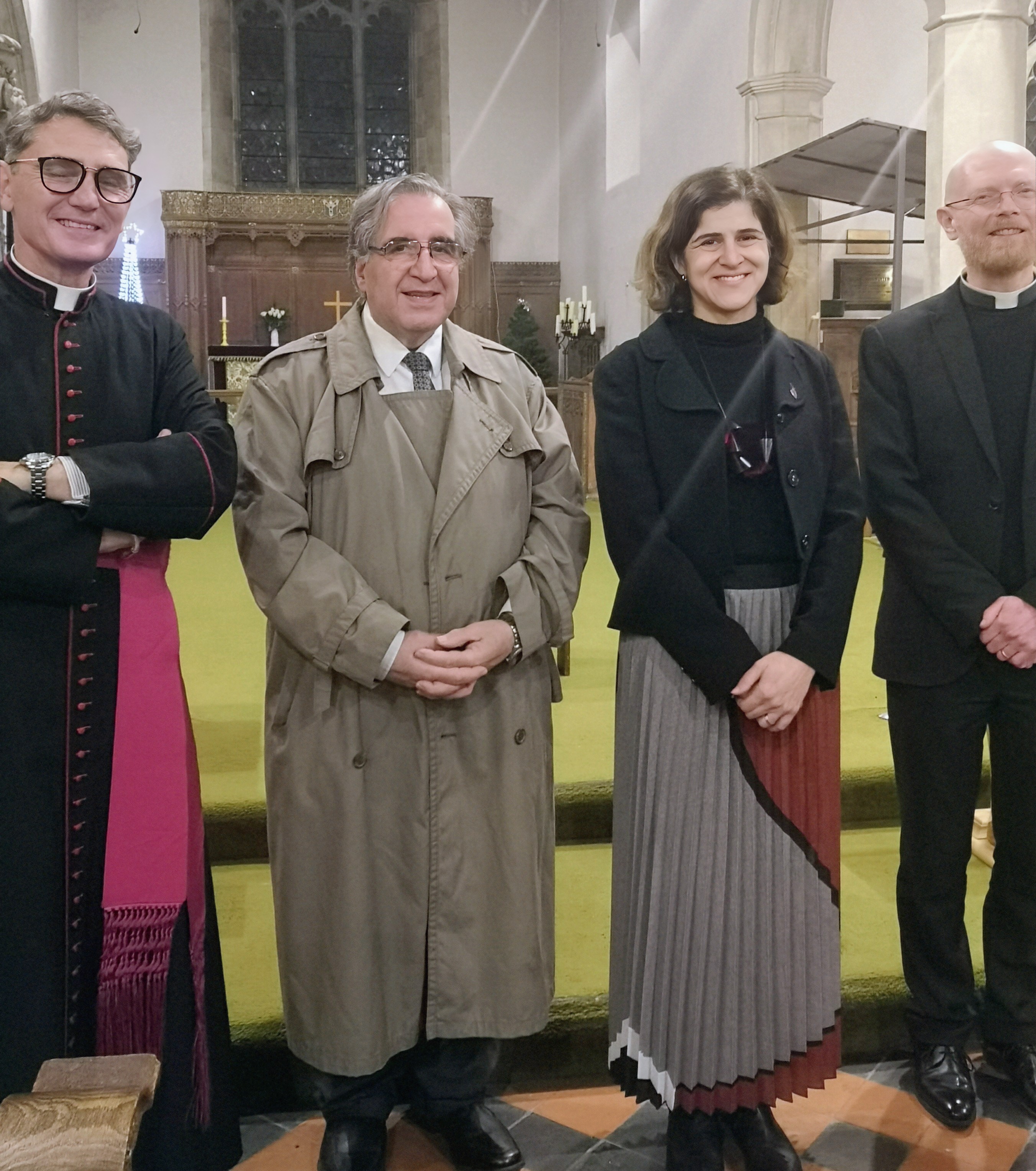
This year, when the country was commemorating the 80th anniversary of the liberation of Auschwitz, we at St Mary at Finchley held our annual commemoration event. Our guests included two or three local clergy, two rabbis, the Bishop of Edmonton and the Archdeacon of Hampstead. Around 100 people attended. In addition, several local politicians come and this year our new MP, Sarah Sackman, attended and spoke about a personal connection.
Our main speaker was a local Jewish lady whose mother had several times fled the Nazis in her native France, as they came upon each of her hiding places.
The service is a peaceful and reflective one. We share a commitment in saying about genocides ‘Never Again’. We each light a candle at the end of the service and we enjoy a chat over wine, tea, coffee and cake immediately afterwards. The cake is always a specially decorated one from the local kosher cake shop. We Christians are always touched by the thanks and appreciation of the many Jewish guests.